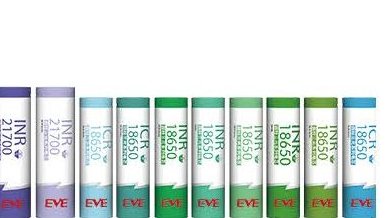
Published 2026-10-12 · Figures from EVE Energy published specifications
Cordless tool packs are built from either 18650 cells (18 mm × 65 mm) or 21700 cells (21 mm × 70 mm). The larger cell has become the default for new high-power tools. Here is why, using EVE's published figures.
The numbers
| Cell | Capacity | Energy | Max. continuous discharge | Weight | Cycles |
|---|---|---|---|---|---|
| 18650 20P | 2,000 mAh | 7.2 Wh | 30 A | 45 g max | 300 |
| 18650 25P | 2,500 mAh | 9.0 Wh | 30 A | 48 g max | 300 |
| 21700 40P | 4,000 mAh | 14.4 Wh | 50 A | 70 g max | 300 |
| 21700 50E | 5,000 mAh | 18.3 Wh | 15 A | 71 g max | 1000 |
Energy is capacity × nominal voltage (3.6 V for the P-series, 3.65 V for 50E).
Fewer cells for the same pack
An 18V tool pack uses 5 cells in series (5S). To reach 4 Ah:
- with 18650 25P cells you need 5S2P = 10 cells (5.0 Ah)
- with 21700 40P cells you need 5S1P = 5 cells (4.0 Ah)
Half the cells means fewer welds, a simpler BMS and lower assembly cost. The 21700 40P also handles 50 A continuous against 30 A for the 25P, so a single string can feed a high-torque brushless motor.
High-rate vs high-energy cells
Do not compare only capacity. The 21700 50E holds 25% more charge than the 40P but is rated for 15 A continuous discharge, not 50 A. It is a range cell for e-bikes and portable storage, not a drill cell. For tools that need both, EVE lists the 21700 50PL: 5000 mAh at a 14C rating.
When 18650 is still right
- Compact tools, trimmers and handheld vacuums where the pack shape is fixed around 18650 holders.
- 12V-class tools (3S) where a 3S1P 18650 pack already meets the runtime target.
- Existing certified packs where changing cells would mean re-testing.
Bottom line
For new 18V and 36V tools, 21700 high-rate cells (40P, 50PL) give the same capacity with half the cells and more current headroom. Use 18650 cells where the form factor or an existing certification makes them the practical choice.