Published 2026-10-12 · Figures from EVE Energy published specifications
Battery-powered meters and sensors are designed to run for a decade or more without a battery change. Two primary lithium chemistries dominate: lithium thionyl chloride (Li-SOCl₂, model prefix ER) and lithium manganese dioxide (Li-MnO₂, prefix CR). Here is how to choose.
Side by side
| Li-SOCl₂ (ER) | Li-MnO₂ (CR) | |
|---|---|---|
| Nominal voltage | 3.6 V | 3.0 V |
| Service life (EVE series data) | up to 20+ years | 10+ years |
| Self-discharge at room temperature | ≤ 1% per year | ≤ 1% per year |
| Operating temperature (EVE series data) | −55 °C to +85 °C | model dependent |
| Pulse capability | limited on its own | strong across the life |
| Typical uses | water, gas and heat meters, trackers, data loggers | security sensors, TPMS, medical devices, electronic shelf labels |
Why ER cells lead in metering
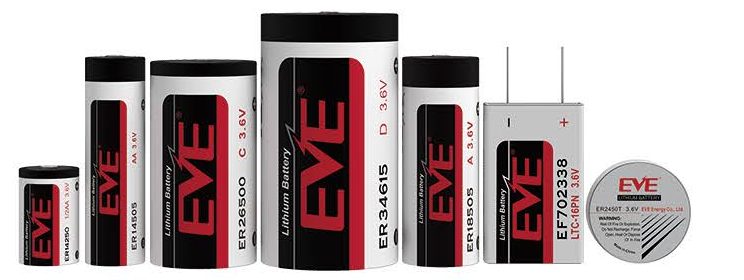
Li-SOCl₂ has the highest energy density of common primary chemistries and a flat 3.6 V discharge. A D-size ER34615 stores 19,000 mAh, which is why it is a common choice for long-life utility meters. Its weakness is pulse current: after long storage a passivation layer forms on the lithium and the voltage can dip when a radio suddenly draws current.
Fixing the pulse problem: ER+SPC
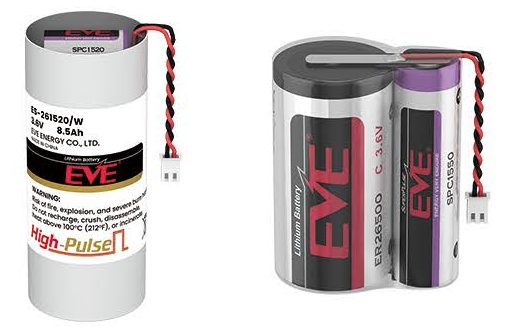
An SPC battery capacitor wired in parallel with the ER cell supplies the short high-current pulses while the ER cell recharges it slowly. EVE's ER+SPC hybrids, such as ER34615+SPC1520 and ER26500+SPC1550, are made for NB-IoT, LoRa and wM-Bus meters that transmit regularly. EVE lists high stable voltage with no voltage delay and operation from −40 °C to +85 °C.
When CR cells are the better choice
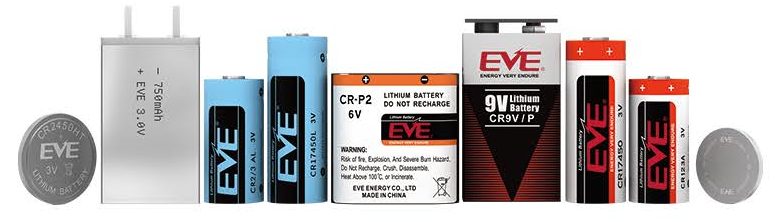
Li-MnO₂ cells have lower energy density but deliver pulses well throughout their life and suit devices with frequent activity: door sensors, smoke alarms, tracking tags and remote keys. CR123A and the CR2032 coin cell are the common formats.
A quick selection guide
- Meter or sensor reporting a few times per day, 10+ year life: ER14505, ER26500 or ER34615
- Meter with a cellular or LoRa radio: ER+SPC hybrid
- Small sensor with frequent pulses or a coin-cell slot: CR2032, CR2450 or CR123A
- Extreme cold outdoors: check the ER datasheet derating curves at your lowest temperature
Share your device's sleep current, pulse profile and target life and we will propose cell options with datasheets.