Updated 2026-10-13 · By the WattSourcing sourcing team · Figures from EVE Energy published specifications
- Low-voltage (LV) home batteries run at 51.2V nominal ("48V"); high-voltage (HV) systems stack packs in series to 100–600V. The choice is set by your hybrid inverter's battery input, not by the battery alone.
- At the same power, an HV battery carries far less current: 10 kW is about 195 A at 51.2V but only about 33 A at 307.2V. Less current means thinner cables and lower losses.
- LV systems stay below the 60V DC extra-low-voltage threshold (16 LFP cells reach 58.4V at full charge), which keeps installation and service simpler.
- LV is the usual choice up to roughly 15–25 kWh and 5–10 kW; HV wins for larger homes, 3-phase inverters and small businesses.
- Size on usable energy: nominal kWh × depth of discharge. EVE's 5.12 kWh packs give about 4.6 kWh usable at 90% DoD.
Most solar homes now add a battery, and the first technical question is whether it should be a low-voltage 48V battery or a high-voltage stack. Both use the same LiFePO4 chemistry, and EVE Energy builds both from the same 5.12 kWh, 16-cell pack. What changes is how the packs are connected, which inverter they work with, how much current flows and how the system grows. This guide explains the trade-offs and walks through sizing with EVE's residential range.
What "low voltage" and "high voltage" mean
A LiFePO4 cell has a nominal voltage of 3.2 V. Sixteen cells in series (1P16S) make a 51.2 V pack, the format sold as a "48V" home battery. Its voltage swings from about 40 V when empty to 58.4 V when full (16 × 3.65 V).
- Low-voltage (LV) systems connect 51.2 V packs in parallel. Voltage stays at 51.2 V and capacity adds up: two 100 Ah packs give 200 Ah.
- High-voltage (HV) systems connect packs in series. Capacity stays at 100 Ah and voltage adds up: five packs give 256 V, six give 307.2 V, twelve give 614.4 V.
EVE's range shows both approaches built on the same pack:
| System | Architecture | Nominal voltage | Energy | Usable at 90% DoD |
|---|---|---|---|---|
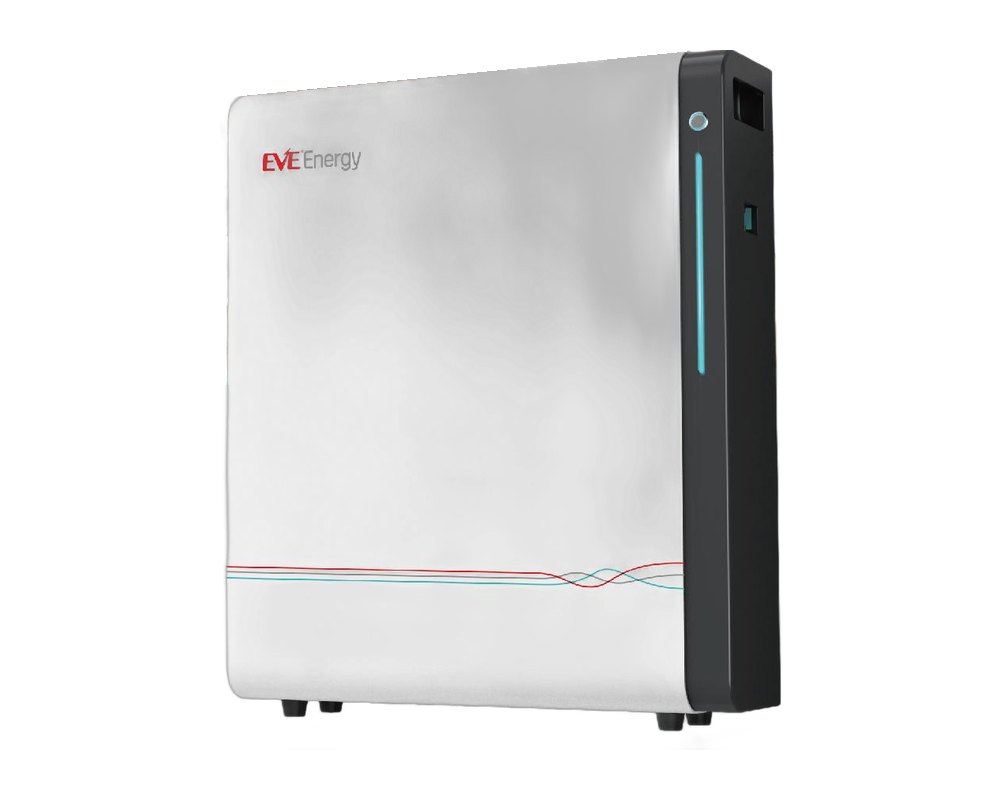
| EVE-LVW-5.0 | LV, wall-mounted | 51.2 V | 5.12 kWh | ≈ 4.6 kWh |
| PLW-I-10.0 | LV, wall-mounted (2P16S) | 51.2 V | 10.24 kWh | ≈ 9.2 kWh |
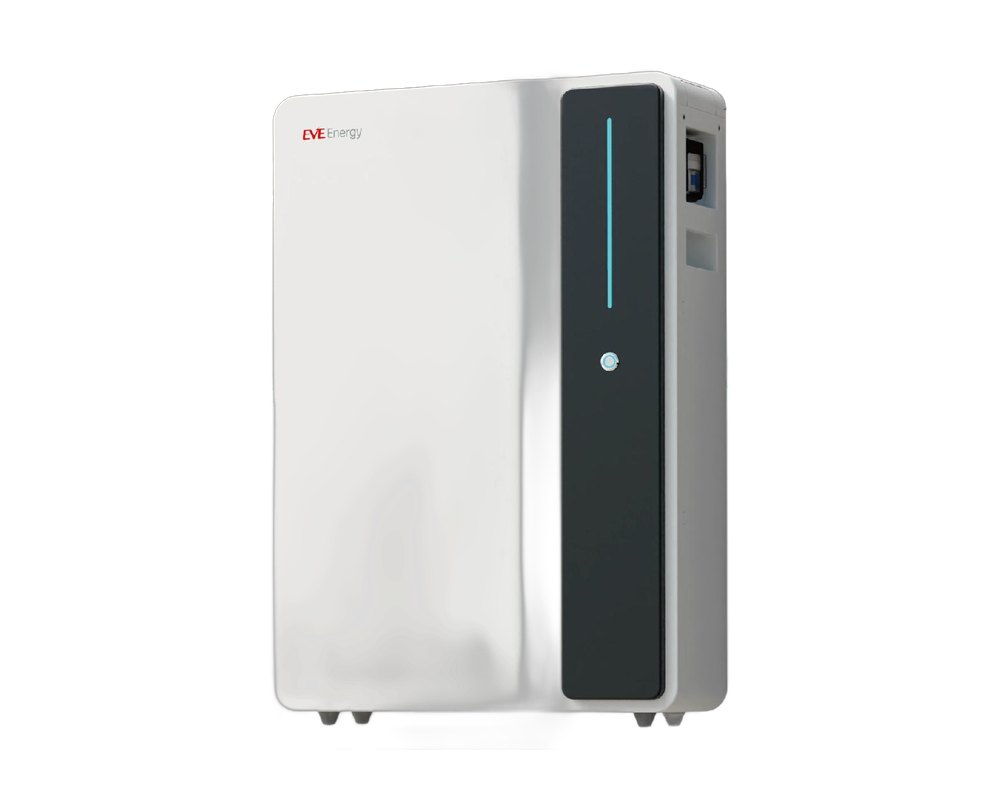
| RES-PLW-16.0 | LV, single large pack | 51.2 V | 16.07 kWh | ≈ 14.5 kWh |
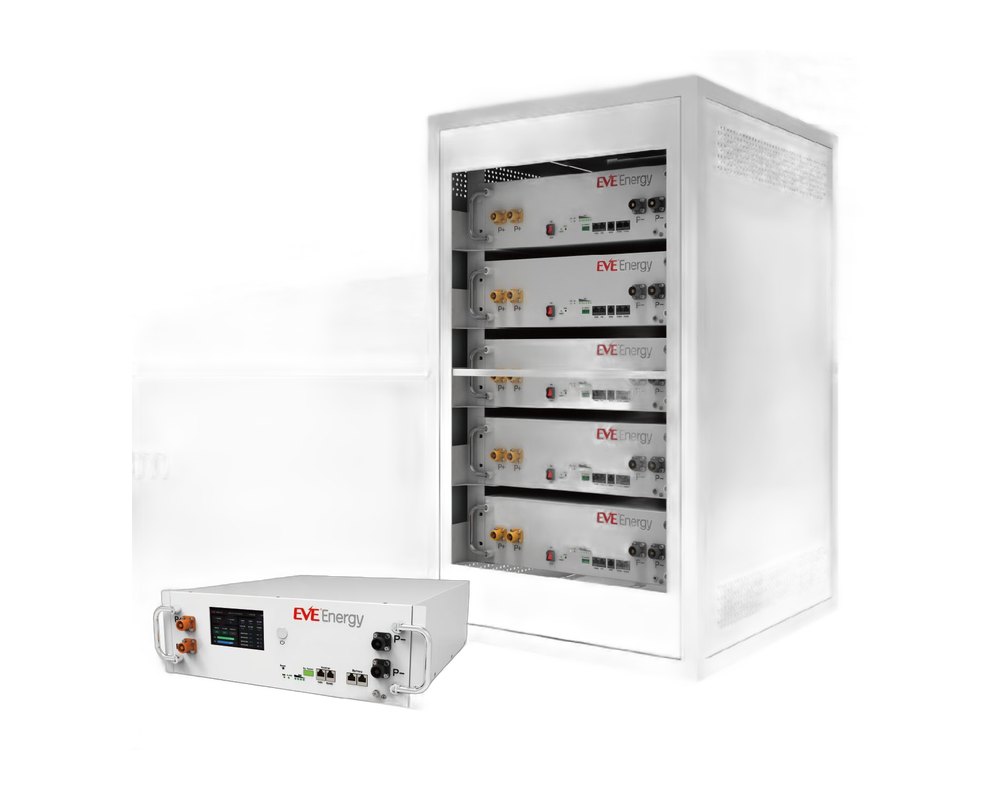
| EVE-LVI-15.0 | LV, rack (3 packs) | 51.2 V | 15.36 kWh | ≈ 13.8 kWh |
| EVE-LVI-25.0 | LV, rack (5 packs) | 51.2 V | 25.6 kWh | ≈ 23.0 kWh |
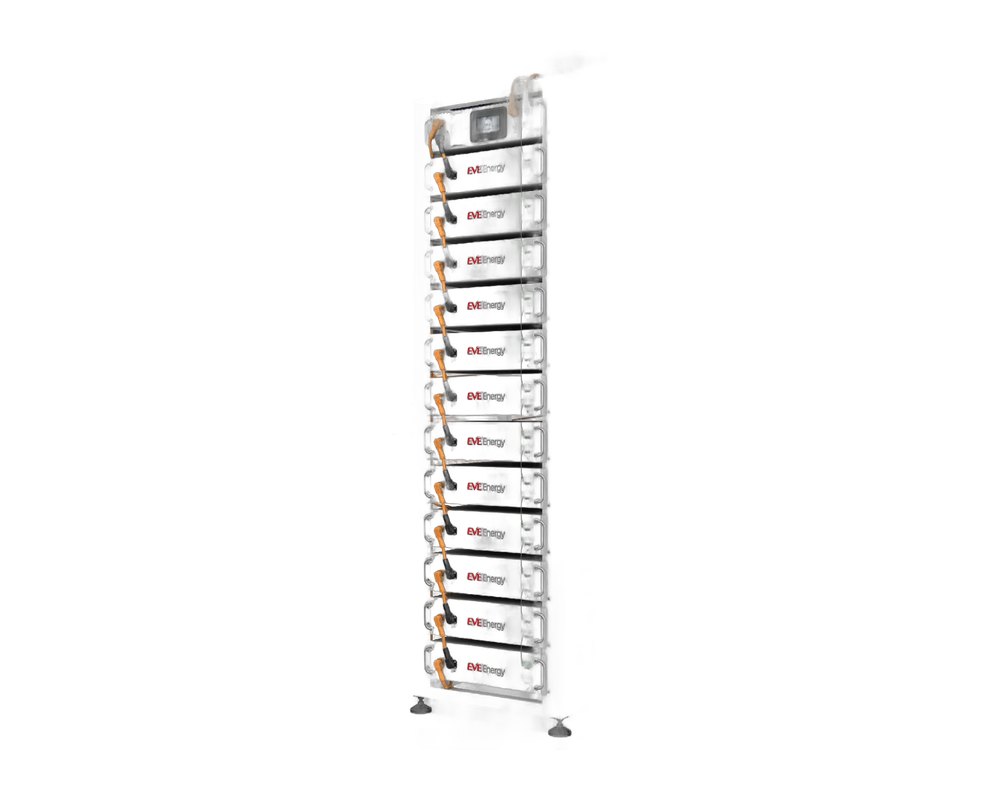
| RES-CHS-I-25.0 | HV, stacked, IP65 (5 in series) | 256 V | 25.6 kWh | ≈ 23.0 kWh |
| EVE-HVI-30.0 | HV, subrack (6 in series) | 307.2 V | 30.72 kWh | ≈ 27.6 kWh |
| EVE-HVI-60.0 | HV, subrack (12 in series) | 614.4 V | 61.44 kWh | ≈ 55.3 kWh |
Usable energy is nominal energy × the 90% depth of discharge EVE lists for these systems. Inverter and battery losses reduce the energy delivered to your loads a little further.
Current: the difference that drives everything else
Power equals voltage times current, so the same power needs much less current at high voltage:
| Battery power | At 51.2 V (LV) | At 256 V | At 307.2 V | At 614.4 V |
|---|---|---|---|---|
| 5 kW | ≈ 98 A | ≈ 20 A | ≈ 16 A | ≈ 8 A |
| 10 kW | ≈ 195 A | ≈ 39 A | ≈ 33 A | ≈ 16 A |
| 20 kW | ≈ 391 A | ≈ 78 A | ≈ 65 A | ≈ 33 A |
This has three practical consequences:
- Cable and busbar size. A 10 kW LV system needs heavy DC cables, large lugs and high-current fuses. The same power at 307 V runs on cable comparable to ordinary household wiring.
- Losses. Resistive loss rises with the square of current. For the same cable, six times the voltage means one thirty-sixth of the cable loss at the same power.
- Power per pack. An LV pack such as EVE-LVW-5.0 is rated for 100 A continuous discharge, about 5.1 kW. To deliver 10 kW from an LV bank you need at least two packs in parallel. An HV string of 100 Ah packs can deliver far more power at the same current; EVE states its HVI platform reaches up to 60 kW of discharge per cluster.
Safety and installation
A 16-cell LFP pack peaks at 58.4 V, which stays below the 60 V DC extra-low-voltage threshold used in many electrical codes. That is the main reason LV batteries are popular with installers: packs can be handled, added and swapped with standard precautions, and the system tolerates a wider range of installer experience.
HV systems operate well above that level, so they rely on a high-voltage box with fuse, breaker and contactor, insulation monitoring and stricter installation rules. EVE's HVI systems include an HV box with fuse and breaker and three-level BMS warnings. HV is entirely safe when installed correctly, but it should be installed and serviced by qualified electricians, and local rules for DC voltage above 60 V apply.
Matching the inverter
The inverter decides. Hybrid inverters are built for either an LV battery input (typically around 40–60 V) or an HV input with a specific voltage window. Before choosing a battery, check:
- Battery voltage range of the inverter, and whether your HV string stays inside it from empty to full. The RES-CHS-I-25.0, for example, has a system voltage range of 102.4–409.6 V.
- Maximum charge and discharge current or power at the battery port.
- Communication protocol (CAN or RS485) and whether the inverter brand lists the battery. EVE lists compatibility with Megarevo, GoodWe, Growatt, Pylontech, Deye and Solis inverters across its residential range.
- Phase: single-phase homes commonly use LV; three-phase inverters for larger homes are frequently HV.
If you want one box instead of a separate inverter and battery, the RES-SLS-I-5.0 combines a 6 kW hybrid inverter (12 kVA surge for 5 s), 7 kW PV input and 5.12–15.36 kWh of LV storage in one floor-standing unit.
Expansion: parallel vs series
- LV grows by adding packs in parallel. EVE's PLW-I-10.0 supports up to 15 packs in parallel. Each added pack raises both energy and available current. Add new packs as early as possible and let the BMS balance them; mixing very old and new packs reduces the usable capacity of the bank.
- HV grows by adding packs to the string, which raises voltage. The string must stay inside the inverter's voltage window, so expansion steps are fixed by design. Larger HV systems add strings or cabinets in parallel; EVE's 60 kWh outdoor cabinet allows up to four cabinets in parallel.
How to size a home battery in five steps
- Night-time consumption. From the electricity bill or a smart meter, find daily use and the share used after sunset. Example: 18 kWh per day, 60% after sunset = 10.8 kWh.
- Backup requirement. Decide which loads must run in a power cut and for how long. Add this as reserve if outages are common.
- Usable energy target. Add 10–15% for losses: 10.8 kWh × 1.12 ≈ 12 kWh usable.
- Nominal size. Divide by depth of discharge: 12 ÷ 0.9 ≈ 13.4 kWh nominal. Options: three 5.12 kWh packs (15.36 kWh), the EVE-LVI-15.0, or one RES-PLW-16.0.
- Power check. Compare the battery's continuous power with peak household load and the inverter rating. If the house peaks at 8 kW, a single 5 kW-class LV pack is not enough; two or more packs in parallel, or an HV system, are needed.
Which architecture fits which home
| Situation | Usual choice | EVE examples |
|---|---|---|
| Apartment or small home, 5–10 kWh, single-phase | LV wall-mounted | EVE-LVW-5.0, RES-PLW-III-5 (IP65), PLW-I-10.0 |
| Family home, 10–25 kWh, existing LV hybrid inverter | LV wall or rack | RES-PLW-16.0, EVE-LVI-15.0, EVE-LVI-25.0 |
| Outdoor installation, garage wall or patio | IP65 LV or HV | RES-PLW-III-5, RES-CHS-I-25.0 |
| Large home, three-phase, EV charging or heat pump | HV stack | RES-CHS-I-25.0, EVE-HVI-30.0 |
| Farm, villa or small business, 30–250 kWh | HV subrack or outdoor cabinet | EVE-HVI-60.0, 60 kWh outdoor cabinet (up to 4 in parallel) |
| New installation wanting one product | All-in-one | RES-SLS-I-5.0 |
Notes for distributors and installers
- Carry both lines. LV covers most retrofit jobs on existing inverters; HV covers premium and three-phase projects. Using one cell and pack platform for both simplifies spares and training.
- Certification by market. EVE lists UN38.3, CE and IEC 62619 across the range, with UL 9540A tests and UL 1973 design on several models. Confirm the documents your market and utility require before ordering.
- Private label. EVE offers its home batteries for OEM/ODM, including logo, colour and packaging. See OEM / ODM.
Bottom line
Choose low-voltage 51.2 V batteries for single-phase homes up to roughly 15–25 kWh, for retrofits on existing LV inverters, and where easy installation matters most. Choose high-voltage stacks for larger homes, three-phase inverters, high power demand and small businesses. Either way, size on usable energy, check continuous power against peak load, and confirm the inverter's voltage window and protocol first. Send us your inverter model, daily consumption and target market and we will propose an EVE configuration with datasheets and pricing.
Frequently asked questions
Is a 48V battery the same as a 51.2V battery?
Yes, in practice. "48V" is the traditional system class; a 16-cell LiFePO4 pack has a nominal voltage of 51.2V and works with 48V-class inverters.
Can I connect a low-voltage battery to a high-voltage inverter?
No. The battery voltage must fall inside the inverter's battery input window. An LV battery needs an LV hybrid inverter, and an HV string needs an HV inverter whose range covers the string from empty to full.
Is a high-voltage home battery more efficient?
Usually somewhat, because lower current means lower cable and conversion losses, especially at high power. The difference is smaller for small systems running at a few kilowatts.
How many 5.12 kWh packs do I need?
Divide your usable-energy target by about 4.6 kWh (5.12 kWh at 90% depth of discharge). For 12 kWh usable, three packs are a good fit. Then check that the packs together can deliver your peak power.
Which EVE home batteries are suitable for outdoor installation?
RES-PLW-III-5 and RES-CHS-I-25.0 are rated IP65, and the 60 kWh outdoor cabinet is rated IP55. The other models are IP20 and intended for indoor installation.