Updated 2026-10-15 · By the WattSourcing sourcing team · Figures from EVE Energy published specifications
- Every datasheet number is only meaningful with its test conditions: rate, temperature, depth of discharge and end-of-life criterion.
- C-rate is current relative to capacity; P-rate is power relative to energy. A 314Ah cell at 0.5P carries about 157 A; a 4,000 mAh cell at 50 A is running at 12.5C.
- Cycle life to 70% end-of-life is not comparable with cycle life to 80%. EVE rates the LF280K at ≥ 8000 cycles to 70% and the LF100LA at ≥ 5000 cycles to 80%.
- LFP cells can be discharged far below 0 °C but are charged only from 0 °C upwards; check the charging window, not just the operating range.
- AC internal resistance is a key value for grading and matching cells in a pack; ask for it per cell with every lot.
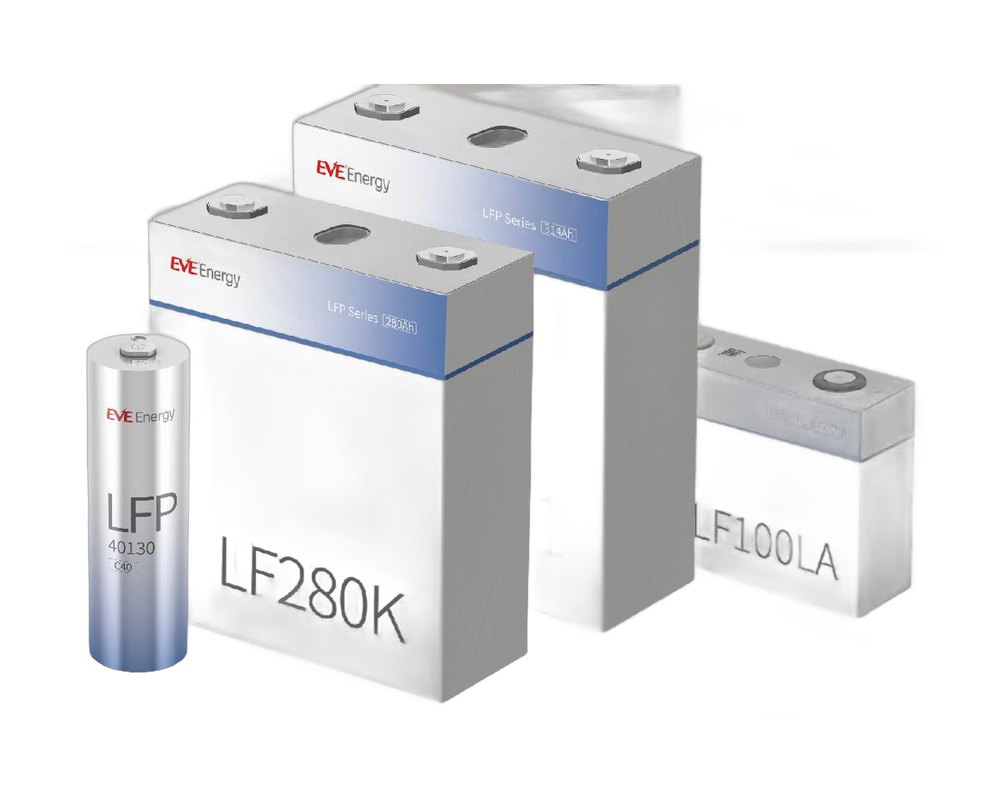
A cell datasheet is the contract between the manufacturer and your design. Most sourcing mistakes, from overheating tool packs to home batteries that fade early, come from reading a number without its test conditions. This guide walks through each section of a typical lithium cell datasheet, using EVE's published figures for the MB31, LF280K, 21700 40P and others.
Capacity: nominal, rated and minimum
Capacity is the charge a cell delivers from full to the discharge cut-off voltage, in ampere-hours (Ah) or milliampere-hours (mAh). Datasheets may list a nominal or typical value and a minimum value; the minimum is the one to design to. Capacity is always measured at a stated rate and temperature, usually a slow rate at 25 °C, and it drops at high current and in the cold.
Energy is capacity times nominal voltage. Comparing cells of different chemistries by Ah is misleading: a 3,500 mAh NCM cell at 3.65 V stores 12.8 Wh, while a 3.2 V LFP cell needs 4,000 mAh for the same energy.
Voltage: nominal, charge limit and cut-off
| LFP (e.g. MB31, LF280K) | NCM (e.g. 21700 40P) | |
|---|---|---|
| Nominal voltage | 3.2 V | 3.6–3.65 V |
| Charge limit | 3.65 V | 4.2 V |
| Discharge cut-off | 2.5 V | 2.5 V |
The BMS must keep every cell inside this window. Charging above the limit or discharging below the cut-off damages the cell and is a safety risk. LFP's flat voltage curve is good for power electronics but makes state-of-charge estimation by voltage alone difficult, which is why LFP BMSs rely on current counting and periodic calibration.
C-rate and P-rate
C-rate expresses current relative to capacity: 1C on a 100 Ah cell is 100 A, 0.5C is 50 A. P-rate, used for energy-storage cells, expresses power relative to energy: 0.5P on a 1,004.8 Wh cell is about 502 W, so a full charge or discharge takes about two hours.
| Cell | Rated value on datasheet | In amps |
|---|---|---|
| MB31 (314 Ah) | Standard and maximum 0.5P | ≈ 157 A |
| LF280K (280 Ah) | Standard 0.5P, maximum 1P | ≈ 140 A / ≈ 280 A |
| LF100LA (102 Ah) | Standard 0.2C, maximum 1C | ≈ 20 A / ≈ 102 A |
| 21700 40P (4,000 mAh) | 50 A max. continuous discharge | 12.5C |
| 21700 50E (5,000 mAh) | 15 A max. continuous discharge | 3C |
Read three things: the standard rate (used for the cycle-life test), the maximum continuous rate, and any pulse rating with its duration. Designing to the maximum continuous rate all the time shortens life and raises cell temperature; designing around the standard rate gives the datasheet cycle life.
Cycle life and the end-of-life criterion
A cycle-life figure has four hidden variables: charge and discharge rate, depth of discharge, temperature and the end-of-life (EOL) capacity. EVE's datasheets state them explicitly:
- LF280K and MB31: ≥ 8000 cycles at 0.5P/0.5P and 25 °C to 70% EOL
- LF100LA: ≥ 5000 cycles to 80% EOL
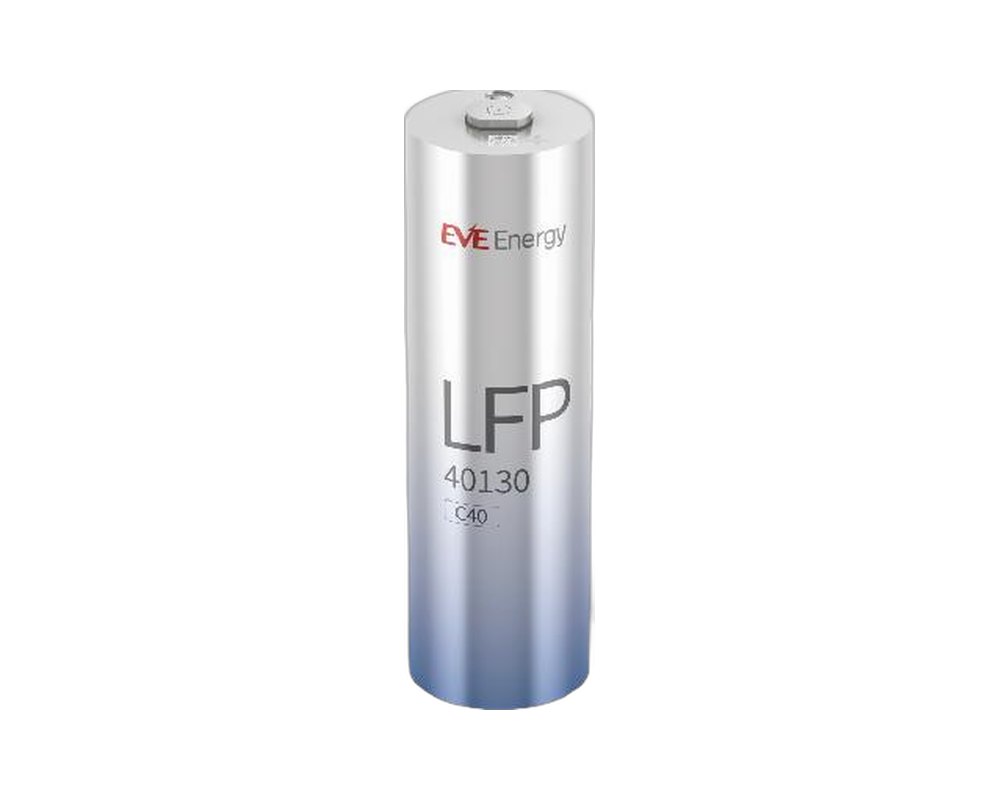
- C40: ≥ 4000 cycles to 80% EOL
- 21700 40P: 300 cycles under its high-current test conditions
A cell rated to 70% EOL will always show more cycles than the same cell rated to 80%, so put candidates on the same basis before comparing. Also check that the test rate matches your application: a home battery cycling at 0.3C will usually outlast its datasheet figure, while a pack run at the maximum rate in a hot enclosure will not reach it. For long-life projects, compare lifetime energy throughput (cycles × energy per cell) rather than cycles alone.
Internal resistance
Datasheets usually give AC internal resistance measured at 1 kHz, for example ≤ 0.25 mΩ for the LF280K and 0.18 ± 0.05 mΩ for the MB31. DC resistance, measured from the voltage drop under a current step, is higher and better predicts heating under load. Internal resistance matters for three reasons:
- Heat: loss is I²R, so at 157 A a 0.2 mΩ cell generates about 5 W.
- Matching: cells in a series string should be grouped by capacity and resistance. Ask for per-cell grading data with each lot.
- Ageing: resistance rises as a cell ages, so tracking it is an early warning for weak cells.
Temperature windows
| Cell | Charging | Discharging |
|---|---|---|
| MB31, LF280K | 0 °C to 60 °C | −30 °C to 60 °C |
| LF100LA | 0 °C to 65 °C | −20 °C to 65 °C |
| C40 | 0 °C to 55 °C | −20 °C to 60 °C |
| Li-SOCl₂ primary (ER series) | not rechargeable | −55 °C to +85 °C |
The charging window is the critical one. Charging lithium-ion cells below 0 °C risks lithium plating, which permanently reduces capacity and can create internal shorts. Batteries for unheated garages, cabins or cold climates need a BMS that blocks or limits charging in the cold, or built-in heating. Capacity and cycle life also fall at sustained high temperature, so thermal design matters as much as the cell choice.
Energy density, dimensions and weight
Gravimetric density (Wh/kg) matters for vehicles and portable products; volumetric density (Wh/L) matters for home batteries and cabinets. Both MB31 and LF280K use the same 173.7 × 71.7 × 207.2 mm can, but the MB31 reaches 179 Wh/kg against 163 Wh/kg. Check dimensional tolerances, the swelling allowance over life, terminal type and torque, and weight tolerance (± 300 g on these prismatic cells) when designing module frames.
Safety and certifications
- UN38.3: transport testing, required for every cell and battery design.
- IEC 62619: safety of industrial lithium cells and batteries, including stationary storage.
- IEC 62133-2: safety of portable lithium cells and batteries.
- UL 1973 and UL 9540A: North American standard for stationary batteries and the thermal-runaway fire test method.
Certificates apply to specific models and versions. Ask for the certificate and test report that name the exact model you are buying, and check the issue date.
Questions to ask before you order
- Is this the current datasheet version, and what changed from the previous one?
- Under what rate, temperature, depth of discharge and EOL criterion was the cycle life measured?
- What are the maximum continuous and pulse currents, and the pulse duration?
- Will cells be supplied from a single lot, graded by capacity and internal resistance, with per-cell data?
- At what state of charge are cells shipped, and what are the storage recommendations?
- Which certificates and UN38.3 documents cover this exact model?
Bottom line
Read every datasheet value together with its conditions, design to the minimum capacity and standard rate, compare cycle life on the same EOL basis, and treat the charging temperature window as a hard limit. If you are comparing several cells, send us your operating profile and we will return the current EVE datasheets with the relevant figures side by side.
Frequently asked questions
What does 1C mean on a battery datasheet?
1C is the current that would charge or discharge the cell's rated capacity in one hour. For a 100 Ah cell, 1C is 100 A and 0.5C is 50 A.
What is the difference between C-rate and P-rate?
C-rate is current relative to capacity in Ah. P-rate is power relative to energy in Wh, and is common on energy-storage cells. For LFP cells the two are similar in practice, but P-rate gives a constant power reference over the voltage curve.
Why do two cells with the same cycle life perform differently?
Their cycle-life tests may use different rates, temperatures, depths of discharge or end-of-life criteria. A rating to 70% EOL will always show more cycles than the same cell rated to 80%.
Can LiFePO4 cells be charged below 0 °C?
Not at normal rates. EVE lists 0 °C as the minimum charging temperature for its prismatic LFP cells. Charging colder risks lithium plating; use a BMS with low-temperature charge protection or heating.
What is AC internal resistance used for?
It is measured at 1 kHz and used to check, grade and match cells. Cells in the same series string should have closely matched resistance and capacity.
More buyer guides
- How to ship lithium batteries: UN38.3, Class 9 and the documents importers need
- 48V low-voltage vs high-voltage home batteries: how to choose and size a solar battery
- 314Ah vs 280Ah LFP cells: which to choose for energy storage
- 18650 vs 21700 cells for cordless power tools
- Li-SOCl₂ vs Li-MnO₂: choosing a primary battery for meters and IoT