Updated 2026-11-10 · By the WattSourcing sourcing team · Figures from EVE Energy published specifications
- LiFePO4 cells charge with constant current, then constant voltage. EVE's maximum charge voltage is 3.65V per cell: 14.6V for 12V, 29.2V for 24V and 58.4V for 48V batteries.
- Many systems charge slightly below the maximum, around 3.45–3.55V per cell, because the LFP voltage curve is flat and the last few millivolts add little energy.
- LiFePO4 does not need a float charge. If the charger requires one, a low setting of about 3.35–3.4V per cell is commonly used.
- Do not charge below 0 °C: EVE specifies charging at 0 °C to 60 °C for the LF280K and MB31. Discharging is allowed down to −30 °C.
- Store LiFePO4 at partial charge, in a cool, dry place, and check it every few months.
Wrong charge settings are one of the most common reasons LiFePO4 batteries lose capacity early or shut down unexpectedly. The rules are simple once you know the cell limits. This guide gives the charge voltages for 12V, 24V and 48V batteries, explains absorption, float and current settings, and covers low-temperature charging and storage, based on EVE Energy's cell datasheets.
How LiFePO4 charging works: CC/CV
LiFePO4 batteries charge in two stages:
- Constant current (CC): the charger supplies a set current while the voltage rises.
- Constant voltage (CV), or absorption: when the battery reaches the set voltage, the charger holds it there while the current falls. Charging ends when the current drops to a set level, often around 0.05C, or after a time limit.
Unlike lead-acid batteries, LiFePO4 does not need equalisation or a permanent float stage. The BMS protects the cells and balances them near full charge.
LiFePO4 charging voltage chart: 12V, 24V and 48V
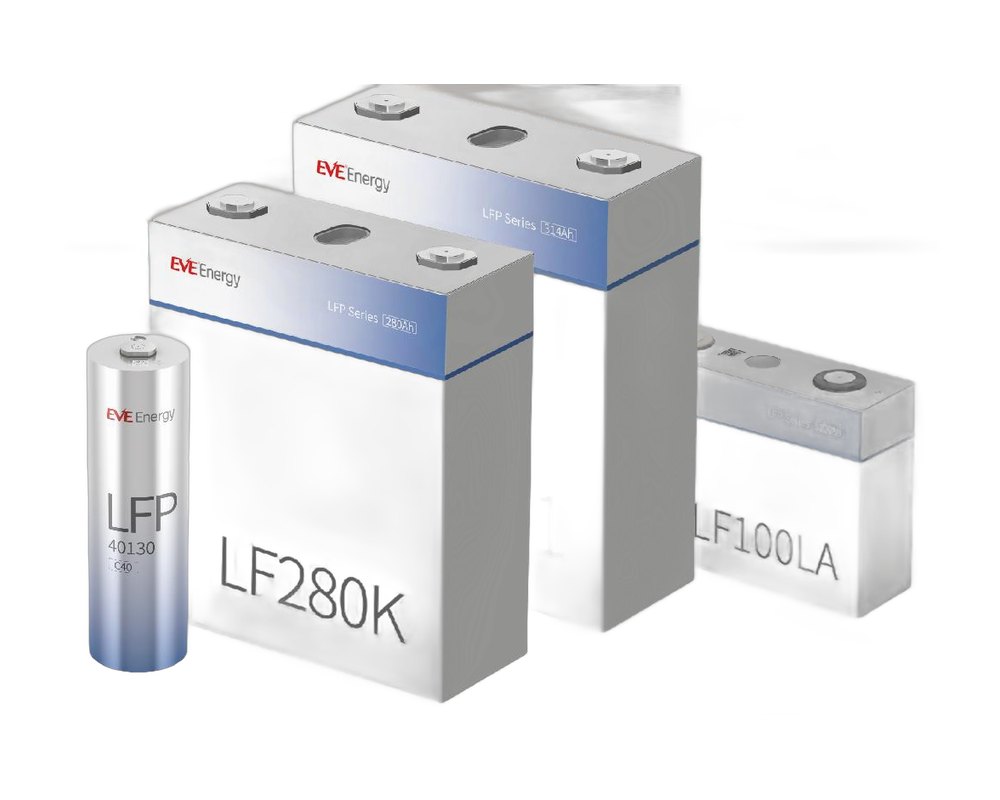
EVE's datasheets for the LF280K, MB31 and LF100LA give a voltage range of 2.5V to 3.65V per cell. The table converts those limits, and commonly used practical settings, to pack voltages:
| Setting | Per cell | 12V (4S) | 24V (8S) | 48V (16S) |
|---|---|---|---|---|
| Nominal voltage | 3.2 V | 12.8 V | 25.6 V | 51.2 V |
| Maximum charge voltage (cell limit) | 3.65 V | 14.6 V | 29.2 V | 58.4 V |
| Typical absorption setting | 3.45–3.55 V | 13.8–14.2 V | 27.6–28.4 V | 55.2–56.8 V |
| Float, if the charger needs one | 3.35–3.40 V | 13.4–13.6 V | 26.8–27.2 V | 53.6–54.4 V |
| Typical low-voltage cut-off | 2.8–3.0 V | 11.2–12.0 V | 22.4–24.0 V | 44.8–48.0 V |
| Minimum discharge voltage (cell limit) | 2.5 V | 10.0 V | 20.0 V | 40.0 V |
The "typical" rows are common practice, not EVE specifications. Always follow the battery manufacturer's or BMS maker's settings when they differ. When a battery talks to the inverter over CAN or RS485, the BMS sets these values automatically.
Why charge a little below 3.65V?
The LiFePO4 voltage curve is very flat between roughly 10% and 90% state of charge, then rises steeply at the top. Charging to about 3.45–3.55V per cell fills almost all the usable capacity, keeps the cells away from the upper limit and gives the BMS time to balance before any cell reaches its protection threshold. Occasional full charges remain useful, because they let the BMS recalibrate its state-of-charge estimate and balance the cells.
Charge current
| Cell | Standard charge | Maximum charge |
|---|---|---|
| LF280K | 0.5P | 1P |
| MB31 | 0.5P | 0.5P |
| LF100LA | 0.2C | 1C |
Charging at the standard rate is gentler and extends life. For a 48V MB31 battery, 0.5P is roughly 157A, well above what most residential inverters deliver. For small 12V batteries such as the BM-12-12.8-180, check that the charger's current suits the battery's rating.
Charging in cold weather: why 0 °C matters
EVE specifies charging temperatures of 0 °C to 60 °C for the LF280K and MB31, and 0 °C to 65 °C for the LF100LA. Discharging is allowed down to −30 °C for the LF280K and MB31, and −20 °C for the LF100LA.
Below freezing, lithium ions cannot enter the graphite anode fast enough, and metallic lithium can deposit on it (lithium plating). This causes permanent capacity loss and can create internal short circuits. In practice:
- Use a BMS with low-temperature charge cut-off, with the sensor on the cells, not on the enclosure.
- For cold sites, use batteries with built-in heating, insulated or heated enclosures, or install the battery indoors.
- Many datasheets also limit charge current at low positive temperatures; check the current-versus-temperature table for your cell.
- A battery can still power loads in the cold. Discharging warms the cells slightly, but charging must wait until they are above 0 °C.
Using lead-acid chargers and solar controllers
- Choose the charger's LiFePO4 or lithium profile, or a user profile with the voltages above.
- Disable equalisation and desulfation modes. Their high voltages can trip the BMS or overcharge cells.
- Set temperature compensation to zero. It is designed for lead-acid batteries.
- For solar charge controllers, set absorption time short, typically from a few minutes to about an hour, because the battery is close to full when the CV stage starts.
Replacing lead-acid in vehicles or boats? See lead-acid to LiFePO4 conversion.
Storing LiFePO4 batteries
- Store at partial charge, commonly around 30–50% state of charge. Full charge in a hot place speeds up ageing; storage near empty risks over-discharge.
- Keep the battery in a cool, dry place, and disconnect loads and the BMS's parasitic drain if the product allows it.
- Check the voltage every three to six months and recharge to the storage level if it has dropped.
- Cells are shipped partly charged. See the shipping guide for state-of-charge rules in transport.
Troubleshooting common charging problems
| Symptom | Likely cause | What to check |
|---|---|---|
| Charging stops before full | One cell reaches its limit first | Cell voltages near full; balance the pack; lower the absorption voltage slightly |
| BMS shuts off in the morning | Low-temperature protection | Cell temperature; heating or indoor installation |
| State of charge drifts | No full charge for weeks | Schedule a periodic full charge to recalibrate |
| Charger shows error with lithium battery | Lead-acid profile or equalisation active | Charger profile and equalisation settings |
Bottom line
Charge LiFePO4 with CC/CV, never above 3.65V per cell. Around 3.45–3.55V per cell is a common, gentle absorption setting; float is optional and low. Never charge below 0 °C, and store batteries partly charged. Cell limits come from the datasheet: see how to read a cell datasheet. Building a pack? Read the 48V 16S pack guide, or ask our engineers about the right cells for your charger and climate.
Frequently asked questions
What is the charging voltage of a 12V LiFePO4 battery?
The maximum is 14.6V (3.65V per cell × 4). Many systems use an absorption setting of about 13.8–14.2V. Follow the battery maker's values if they differ.
What should I set for a 48V LiFePO4 battery?
The maximum is 58.4V for 16 cells. A common absorption setting is about 55.2–56.8V, with low-voltage cut-off around 44.8–48V. Batteries with CAN or RS485 communication set this automatically.
Does LiFePO4 need a float charge?
No. If the charger insists on one, set it low, about 3.35–3.4V per cell (13.4–13.6V for a 12V battery).
Can you charge LiFePO4 below freezing?
No. EVE specifies charging at 0 °C to 60 °C for the LF280K and MB31. Charging below 0 °C can cause lithium plating and permanent damage. Discharging is allowed down to −30 °C.
Can I use a lead-acid charger for LiFePO4?
Only if it has a lithium profile or adjustable voltages, and equalisation and desulfation are disabled.
At what charge level should I store LiFePO4?
Partial charge, commonly around 30–50%, in a cool, dry place. Check the voltage every three to six months.
More buyer guides
- How to build a 48V LiFePO4 battery pack (16S) with 280Ah or 314Ah cells
- How long do LiFePO4 batteries last? Cycle life, calendar life and how to compare ratings
- How to size a commercial battery storage system for peak shaving: a step-by-step guide
- Grade A LiFePO4 cells: how to verify genuine EVE cells and avoid B-grade or refurbished stock
- How to launch a private-label portable power station: models, certifications and the OEM process
- LiFePO4 vs NCM: which lithium battery chemistry is right for your product?
- Replacing lead-acid with LiFePO4 in golf carts, forklifts and boats: sizing, charging and cell choice
- How to ship lithium batteries: UN38.3, Class 9 and the documents importers need
- How to read a lithium cell datasheet: capacity, C-rate, cycle life and the specs that matter
- 48V low-voltage vs high-voltage home batteries: how to choose and size a solar battery
- 314Ah vs 280Ah LFP cells: which to choose for energy storage
- 18650 vs 21700 cells for cordless power tools
- Li-SOCl₂ vs Li-MnO₂: choosing a primary battery for meters and IoT